
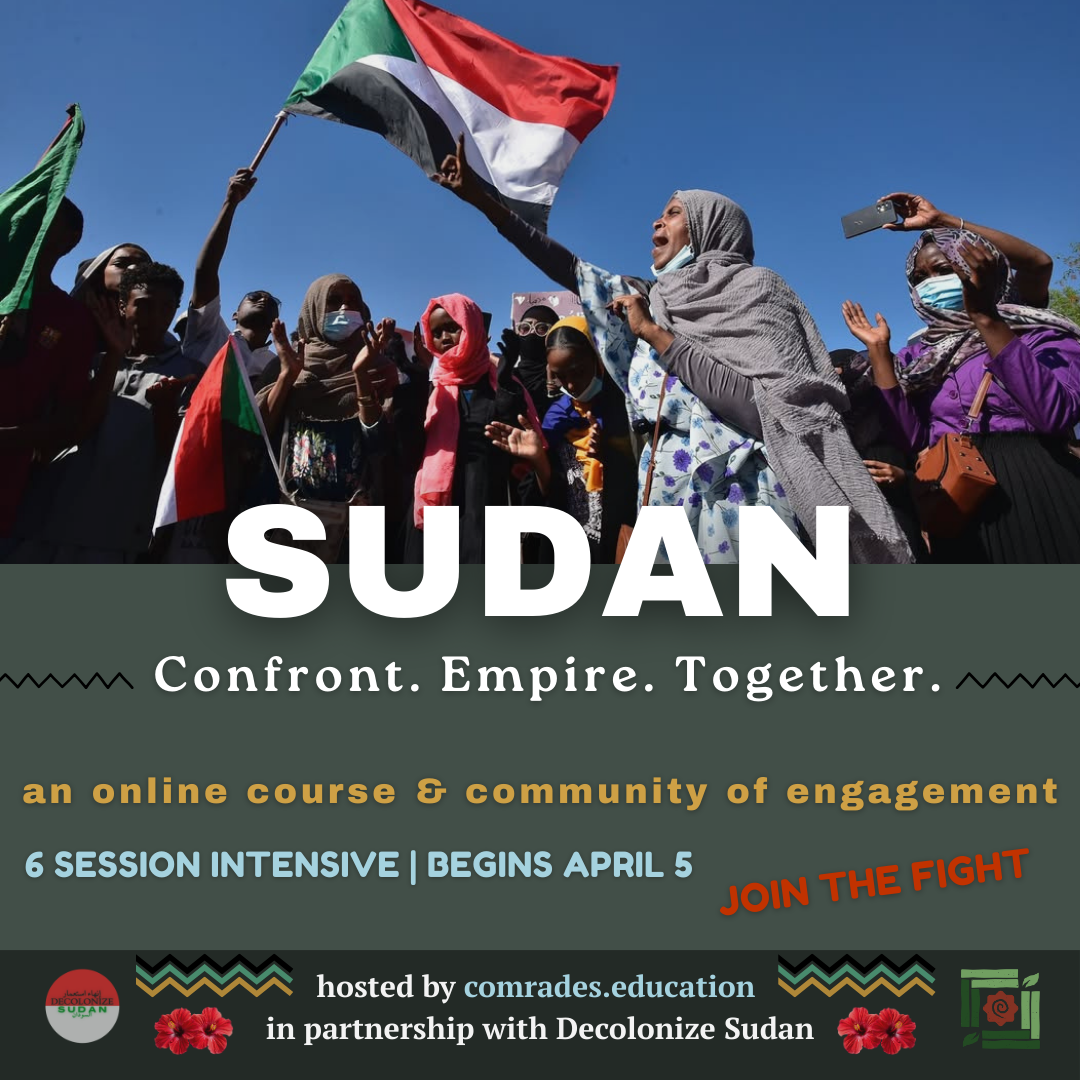
SUDAN
Confront Empire Together
an online course & community of engagement
Facilitators: Suad Abdel aziz & Eleanor Hancock
Guest Teachers: Alaa Salah, Ahmed Kaballo, Noura Erakat, Aaron Maté, Mastora Bakhiet, Ahmed Bashbash, Mutasim Ali, Sarah Ahmed, Geo Maher, Joubin Khazaie, Abraham Paulos & Sara Louis-Ayo
Cosponsors: Adalah Justice Project, Rise Up for Sudan, Catalyst Project, International Human Rights Law Institute & Muslim Students Association National
This course is a partnership between Comrades Education & Decolonize Sudan.
“After the failure of all previous experiments by the governments that came on the heels of wars or revolutions, the authority of the people is the only guarantee for building a just state that can permanently eradicate the roots of those crises and wars. The people’s authority ensures fair representation and distribution of power and wealth and acts as the guardian of the country’s resources.”
- Ra-ad Sahaba, spokesperson for the Revolutionary Charter for Establishing People’s Power (Hammer & Hope, 2024)
What is happening in Sudan is more than a “humanitarian crisis.” It is a crisis of capitalism, white supremacy, imperial violence and neocolonialism. The root cause of this crisis is not tribalism or rivalry but the violent scramble for Sudan’s resources by foreign powers. The ongoing genocide and colonial siege that began in 2023 unfolded in the wake of the Sudanese people’s 2018-2019 revolution, yet the mass's demands for self-determination endure in ongoing resistance at home and in the diaspora.
Education and research are tools of resistance, and knowing the forces behind this violence is critical to building solidarity and action.
SUDAN: Confront Empire Together is a six session online course and community of engagement designed to build awareness and solidarity with the Sudanese people’s struggle for self-determination.
Working with guest teachers from a wide variety of disciplines and experiences, educating ourselves through a connection to Sudanese reporting from the ground, and building our understanding and analysis through six distinct units of study, participants will build our capacity to advocate for and take action in solidarity with Sudan as part of a broader, global struggle.
All of our struggles are connected, and we have much to learn from our Sudanese siblings in what is so clearly an international fight. From ICE to the Epstein files, war on Iran to climate change, the global elite appear to be at war with life itself. No one is safe. Our survival depends on our solidarity with each other.
The goal of this course is not only to understand or bring attention to a dramatically under-reported genocide. It is to help us confront Empire together so that, ultimately, all of us can survive & thrive.
***
Major themes in the course include:
Sudan, Palestine, and the Politics of Solidarity | The Economy of Genocide | Resistance & Gender | Revolution & People’s Power | Borders, ICE & Sudanese Diaspora | Education to Action.
See learning goals & session topics for more detail.
-
Situate Sudan within a global landscape of genocide, neocolonialism, and resistance
Make strategic connections between Sudan and the Palestine solidarity movement
Understand and be able to articulate how genocide emerges not as a breakdown of the system, but as one of its functions.
Reframe how we talk about Sudan in order to shed light on the power structures behind the genocide and empower ourselves others to act
Center the role of Sudanese women’s struggle in the face of gendered violence and leadership in the context of revolution, resistance and community survival
Understand how national borders are weapons of war, and connect our fight against the Trump administration’s assault on immigrants to solidarity with Sudanese refugees
Reflect critically on the role of diasporic populations, and make room for a critique of internal political struggle without playing into externally orchestrated destabilization of an entire country by imperial forces
Translate political education into collective action by identifying concrete pathways for advocacy and sustained solidarity in order to confront empire together.
-
April 5 ➡️ Sudan, Palestine, and the Politics of Solidarity
with guest teachers:
Noura Erakat (human rights attorney and legal scholar)
Ahmed Bashbash (Gazan creator of NoThanks boycott app)
April 12 ➡️ Economy of Genocide: Gold, Arms, Tech & the UAE–RSF Axis Overview
with guest teachers:
Mutasim Ali (chair of the international inquiry into RSF breaches of the Genocide Convention in Darfur)
Ahmed Kaballo (Sudanese activist, political analyst & media entrepreneur)
April 26 ➡️ Resistance, Revolution & Sudanese Women at the Heart of Survival
with guest teachers:
Alaa Salah (Sudanese activist & community leader; iconic representative of 2019 revolution)
Sarah Ahmed (co-founder, Rise Up for Sudan)
Mastora Bakhiet (founder & ED, Darfur Women Network)
May 3 ➡️ Borders As the Second Battlefield: Sudan, Deportation, and Empire in Trump’s America
with guest teachers:
Sara Louis-Ayo from VOTE (Voice of the Experienced) to speak on refugee resettlement
Abraham Paulos (Black Alliance for Just Immigration)
May 17 ➡️ Sudan, Iran, Venezuela, and the Role of U.S. Diaspora Inside Empire
with guest teachers:
Geo Maher, P.h.D (abolitionist educator, organizer & writer)
Aaron Maté (independent journalist & author)
Joubin Khazaie (Iranian American attorney and activist)
May 24 ➡️ From Education to Action: Processing, Strategy, and Solidarity
with Suad & Eleanor
Photo credit: Faiz Abubakr
Course Details


Six live sessions:
April 5, 12, 26 and May 3, 17, 24
4-6pm eastern / 1-3pm pacific
Live attendance is not mandatory.
Sessions will be recorded.
Suggested registration fee: $125-325
No one will be turned away for lack of funds.
*Sudanese youth are encouraged to register at a discounted/scholarship rate.
A portion of all proceeds will be donated to on-the-ground mutual aid efforts in Sudan.
Comrades Education and Decolonize Sudan are US-based organization. We expect to be joined by participants from outside the US, however, there may be times when some adaptation is necessary to apply the work of this course to another location. For information about participant expectations, please see our ground rules document for the course.
Course facilitators

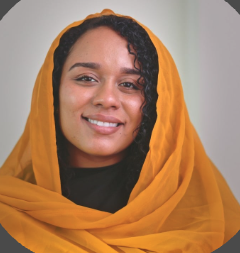

Suad Abdel aziz
is a Sudanese American human rights lawyer and is the founder and ED of Decolonize Sudan. Born and raised in Hasahisa, Sudan, Suad has supported human rights defenders across the Global South and has worked with organizations such as the Southern Center for Human Rights, the National Lawyers Guild and Palestine Legal, advising activists facing repression for their advocacy.
Suad’s advocacy for Sudan pushes back against narratives that prioritize the lens of humanitarian crisis, instead grounding Sudanese struggle in a broader fight against neocolonialism, militarized extraction, and imperial entrenchment. She calls on Sudanese organizers to move beyond NGO saviorism and toward principled, people-powered solidarity rooted in justice, memory, and self-determination.

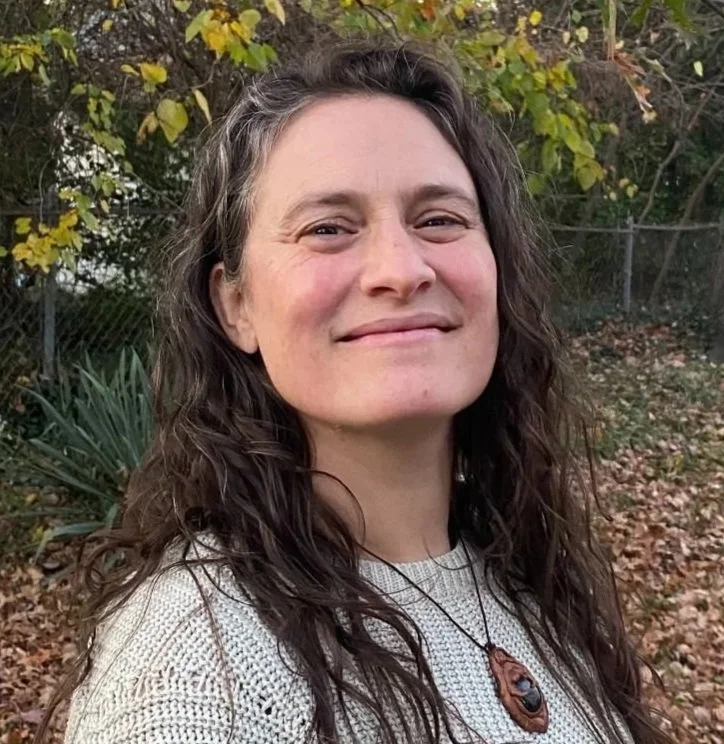
Eleanor Hancock
has built Comrades Education (formerly White Awake) from a small website to an organization of national significance. As founder and director of the organization, Eleanor holds a strong vision for Comrades Education’s work, and has built a supportive team of leadership to guide it. Her leadership grows out of years of experience as an activist, academic, artist, educator, and mother of a multiracial young woman. For more on how Eleanor frames her work, you can listen to this interview on Upstream Podcast.

Guest Teachers
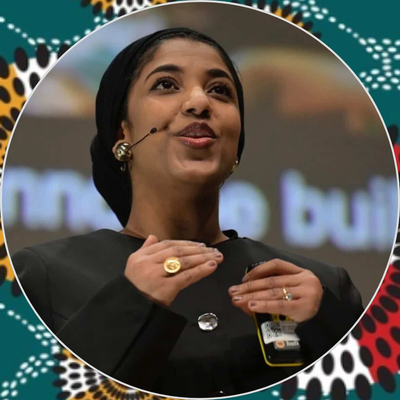
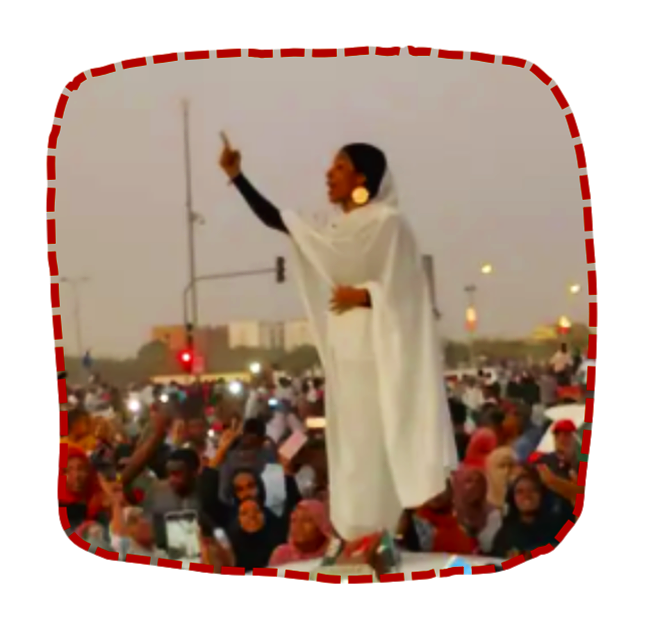
ALAA SALAH is an activist, community leader, and member of MANSAM, a coalition of Sudanese women’s civil and political groups. Alaa gained international media attention when a photograph of her standing on a car leading chants with a crowd of protestors went viral in April 2019. She has been actively involved in post-revolution neighborhood committees, and in Oct, 2019 she represented civil society at the UN Security Council Open Debate on Women, Peace and Security.
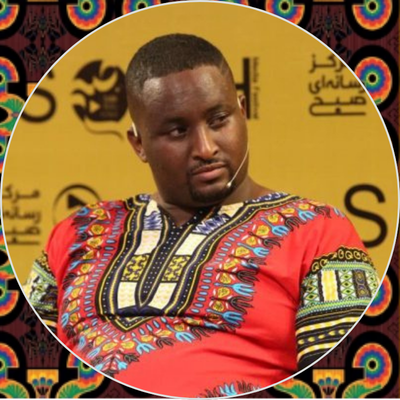
AHMED KABALLO is a Sudanese activist, political analyst and media entrepreneur. He is the founder and CEO of African Stream and subsequently Sovereign Media, platforms dedicated to amplifying African and Global South perspectives on politics, history, and international affairs. Through his commentary and media work, Kaballo provides political analysis on movements for sovereignty and liberation across the African continent.
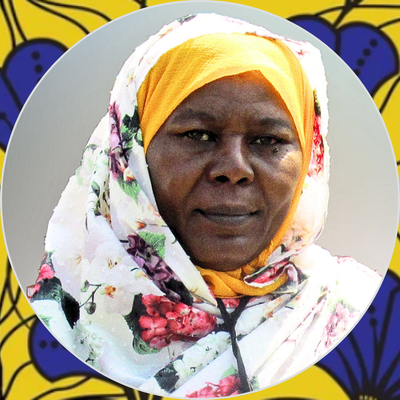
MASTORA BAKHIET is the founder and Executive Director of Darfur Women Network. She holds a master’s of arts degree in Intercultural Service, Leadership, and Management. Ms. Bahkiet has extensive experience in women’s development, economic empowerment, social change, and agriculture and food security. She has a strong connection with those displaced by the Darfur Conflict as well as with refugees from Africa and in the US.
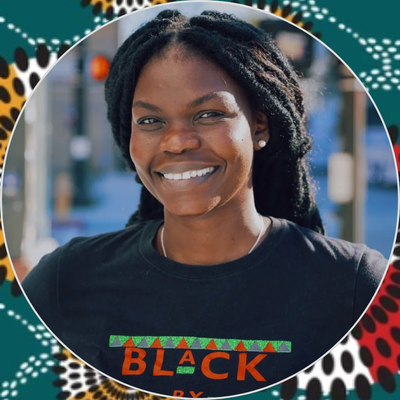
SARA LOUIS-AYO is a community organizer with Voice of the Experienced. Originally from South Sudan, Sara brings s background in history, political science, and public health to her work advancing justice and empowering marginalized communities, particularly those impacted by the criminal justice system. Sara is passionate about restorative justice, women's empowerment, and the inclusion of lived experiences in transforming systemic oppression.
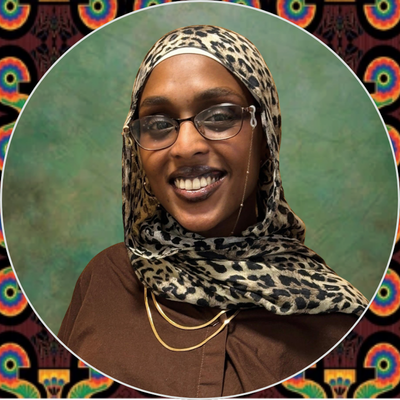
SARAH AHMED is a Sudanese community organizer, longtime activist, and co-founder of Rise Up for Sudan. A survivor of the ongoing war, she channels lived experience into grassroots mobilization, political education, and unapologetic advocacy for women’s rights, justice, dignity, and collective liberation for the Sudanese people.
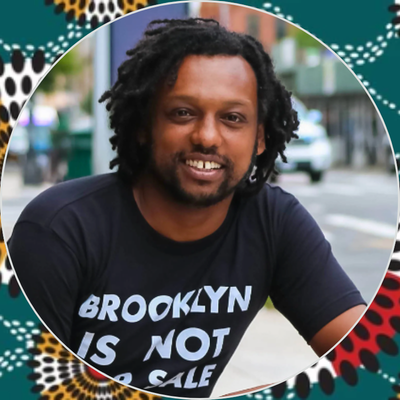
ABRAHAM PAULOS is a seasoned communications expert, journalist, and movement leader who has advocated for human rights for more than a decade. Abraham is currently the Deputy Director of Communications and Policy of the Black Alliance for Just Immigration (BAJI). Before joining BAJI, Abraham was the Executive Director of Families for Freedom (FFF), a position he held after facing immigration detention at Rikers Island and becoming a member of FFF.
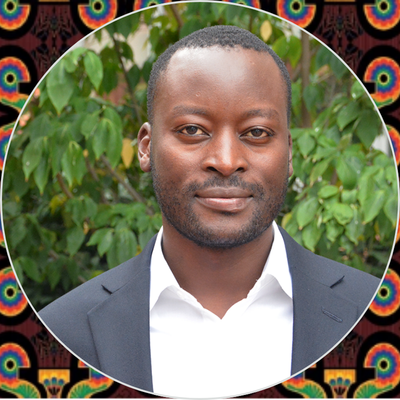
MUTASIM ALI was the chair of the international inquiry into RSF breaches of the Genocide Convention in Darfur. Originally from Darfur, Mutasim has been a displaced person since 2003. A former political prisoner in Sudan, Mutasim is now a legal counsel at The Raoul Wallenberg Centre for Human Rights (RWCHR) where he specializes in targeted human rights interventions and advocacy.
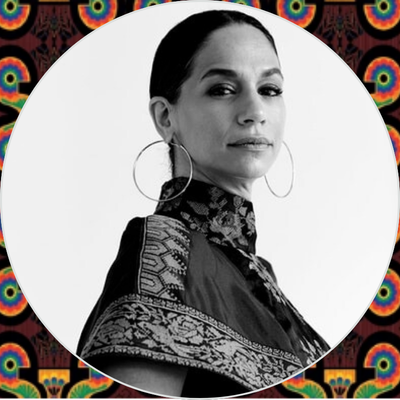
NOURA ERAKAT is a human rights attorney and legal scholar with a distinguished career that includes advocacy at the UN, appearances on CNN, NPR and Democracy Now! and widely published writings.
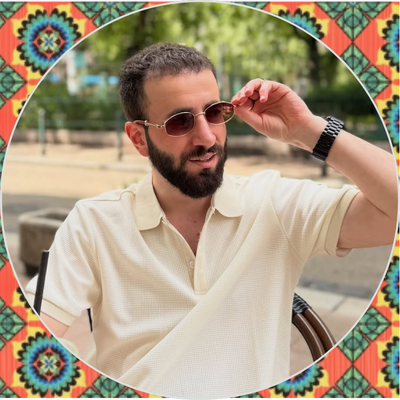
AHMED BASHBASH is a full stack software developer and creator of the NoThanks boycott app. A survivor of the Gaza genocide (now residing in Hungary), Ahmed recently added a Sudan Campaign inside the otherwise Palestinian focused app in solidarity with the Sudanese people.
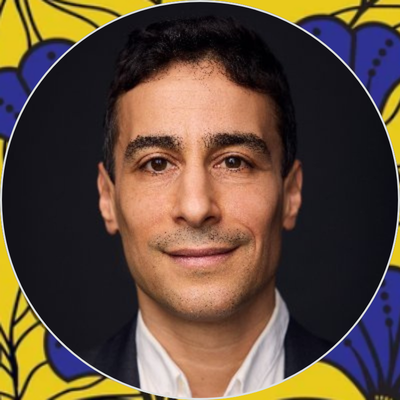
AARON MATÉ is an independent journalist, author, and senior writer for The Grayzone known for analyzing U.S. foreign policy, geopolitical media coverage, and international relations. He co-hosts Useful Idiots with Katie Halper and previously worked for Democracy Now! and Al Jazeera English. Follow Aaron on X and Substack.
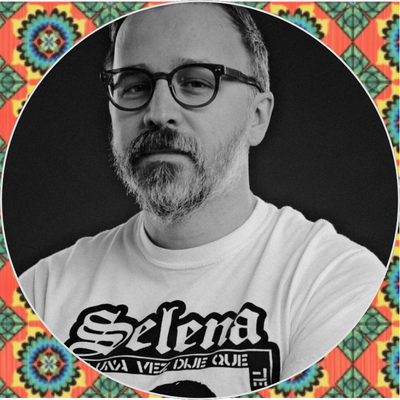
GEO MAHER, Ph.D., is an abolitionist educator, organizer and author who has taught in colleges and universities, in prisons, and in the barrios of Caracas, Venezuela. Growing up poor in the Maine woods, he was taught at an early age to despise oppression, and found early inspiration in local and global struggles against capitalism, colonialism, imperialism, and white supremacy. He is the author of five books, including We Created Chávez, Building the Commune, A World Without Police and Anticolonial Eruptions.
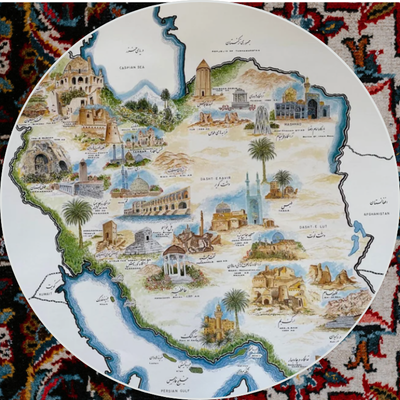
JOUBIN KHAZAIE is an Iranian living in Los Angeles who has worked in eviction defense and tenant's rights for 4 years. He is also a volunteer editor with the Muslim anti-imperialist media publication Vox Ummah, and has been involved in advocacy work regarding sanctions against Cuba, Iran and Venezuela.
What participants have said about our courses
This course is actively supported by our Advisory Council Members:


Katrina Messenger
Betty Burkes
Bonnie Duran
"Why do you charge for your work?"
We believe the work that we do is significant, and we want to do it well. To this end, we charge a modest fee for our online programs, and solicit donations from participants and supporters, in order to meet our financial needs. This allows Comrades Education staff and instructors to focus their time and energy on the educational work this project promotes, for the benefit of all.
Comrades Education and our instructors support a transition away from capitalism, imperialism and white supremacy; we support reparations to historically targeted groups, communities and Peoples; and we make our work available to all regardless of financial means.
If you have further questions, please contact: info@comrades.education